
How Magic Patterns Hit $1M ARR By Turning Away Most Of Their Potential Customers
The contrarian strategic choices two frontend engineers made to generate $500K ARR per employee and a $6M Series A


Zeal CTO Pranab Krishnan spent years writing paragraphs of text trying to communicate UX ideas to his product team.
The words never quite conveyed what he was trying to explain, and that friction only increased as Zeal scaled from two founders to a full product and design team.
Then Krishnan discovered Magic Patterns. Forget text. He could now screenshot the current product, prompt the design, and iterate right there.
“Now I can build what’s in my head, even though I’m not a designer. Magic Patterns makes it easy to show, not tell.”
Magic Patterns’ ability to transform Zeal’s product development cycle represents a shift “left” for greater collaboration earlier in the idea-to-software-delivery flow.
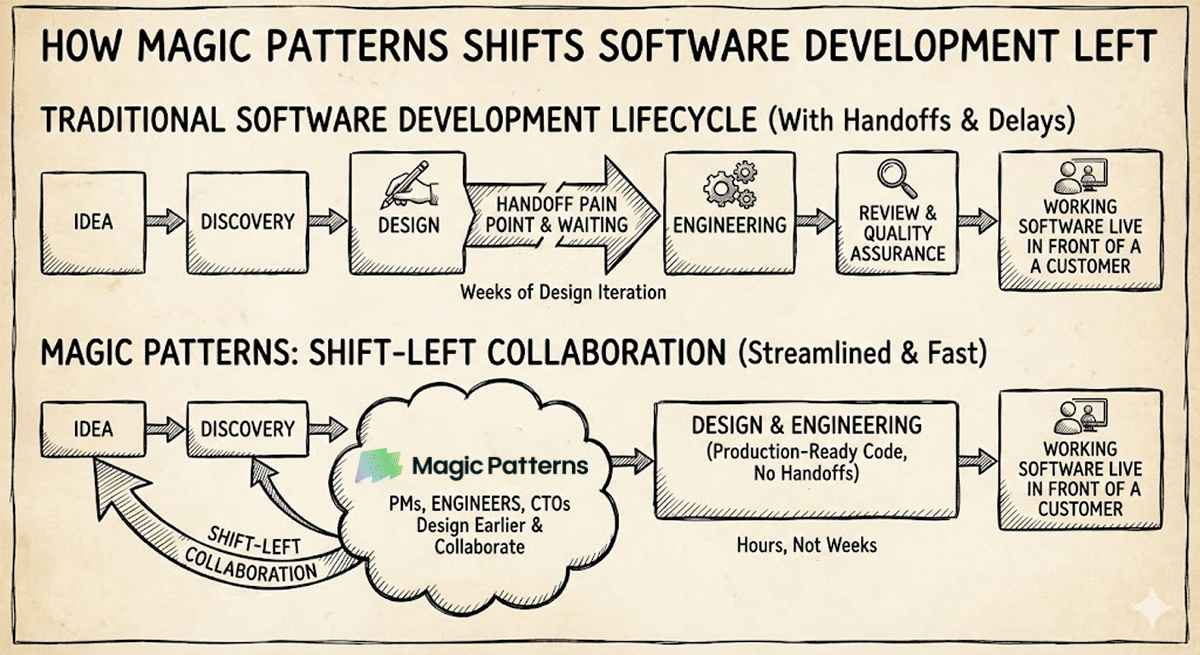
This shift has allowed founders Alexander Danilowicz and Teddy Ni to reach $1M Annual Recurring Revenue (“ARR”) with zero employees and explains why customers gladly pay a premium for their “vibe designing” platform.
From “Silliest Idea” to Series A in 30 Months
“This is the silliest idea I’ve ever heard.”
That’s the blunt assessment Y Combinator partners offered Alexander Danilowicz and Teddy Ni’s text-message analytics startup idea when they applied to Y Combinator in early 2023.
Both founders had spent years building and maintaining design systems at Canopy, LiveRamp, Robinhood, and Instagram. They’d lived the pain of converting Figma mockups to production code while maintaining brand consistency across dozens of components.
The Y Combinator partners suggested they build something leveraging their shared expertise instead.
Over the three-month winter cohort, they iterated through half a dozen product ideas in the design tooling space. A Chrome extension for cloning websites. A component library editor. A design-token manager. Each gained traction but never quite stuck.
What looked like repeated failures turned out to be foundational R&D. Every pivot led back to the same problem: product teams needed consistency across designs, components mattered more than code, and the design-to-development handoff was a pain point for every team.
Their breakthrough crystallized during launch. Instead of replacing Figma or becoming a full-stack builder, they’d solve the specific problem product teams faced: translating design intent into production-ready UI code while respecting existing design systems.
Stealth to $1M ARR
Within two years, Magic Patterns grew profitably to $1M ARR with just two founders and zero employees, achieving what the startup industry considers the gold standard of Series A readiness.
The founders’ “failed experiments” formed the foundation of its competitive advantage: teams could import their exact component libraries via the Chrome extension, prompt feature ideas in natural language, and receive interactive prototypes that precisely matched their brand’s colors, typography, and existing components.
This design system integration became their differentiating competitive advantage. Competitors like v0, Lovable, and Figma Make generate impressive interfaces, but none maintain consistency with real product branding the way Magic Patterns can.
By November 2025, over 1,500 product teams at companies from Y Combinator startups to enterprises were using Magic Patterns daily, collapsing weeks of design iteration into hours.
The Cost of Focus
The founders maintained disciplined “Where to Play” choices: frontend-only, design systems-first, and product teams only. No backend. No generic custom code. No agencies or solopreneurs, though both segments found value.
That focus came at a cost. Both agencies and solopreneurs wanted Magic Patterns, and full-stack builders wanted backend support. The founders said no to all of them, repeatedly, knowing that product teams with design systems offered expansion economics that one-off projects never would.
Every “no” sharpened their differentiation.
Venture-Backed Payday
On November 10, 2025, co-founder Alexander Danilowicz announced Magic Patterns’ Series A for $6M, led by Standard Capital with participation from Y Combinator and other investors. Unusual for an AI startup, the founders had achieved profitability and product-market fit before raising capital, maintaining the discipline that generated $500K ARR per employee.
The Series A capital funds more of the same: frontend engineers, sales talent, and product specialists to expand design system integration while launching Magic Patterns 2.0 with Agent Mode and deeper integration with Figma’s Model Context Protocol (“MCP”).
Magic Patterns’ growth validates its strategic choices: By clearly saying no to what it wasn’t, it’s become irreplaceable at what it is. The design system-aware AI prototyping platform for product teams.
We’ll break down its choices across the Playing to Win cascade to see exactly how Magic Patterns built its competitive differentiation.
Reverse-Engineering Magic Patterns’ Strategy: The Organizational Capability Flywheel
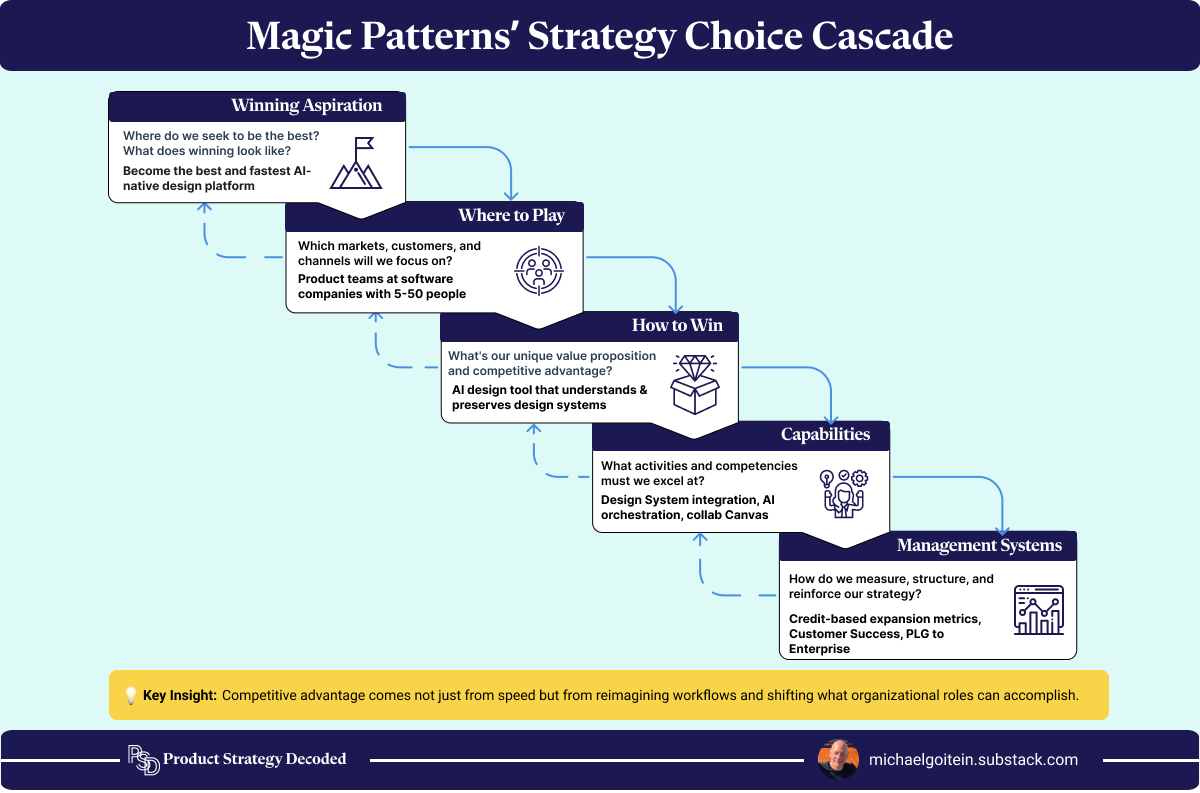
Magic Patterns’ strategy kick-starts a flywheel most AI design tools miss: design system integration enables organizational capability expansion, which drives PLG expansion, which validates focused “Where to Play” choices, which deepens competitive differentiation.
Winning Aspiration: Enable Product Teams to Expand Design Capability Without Expanding Headcount
Magic Patterns aspires to become the best and fastest AI-native design platform product teams use to expand their design capability, reaching 10,000+ organizations by enabling non-designers to ship production-ready features.
Making designers faster is one benefit. Making CTOs into designers, product managers into prototypers, and engineers into design contributors is the transformation.
Already profitable, Magic Patterns aims to scale from $1M to $10M+ ARR while maintaining its reputation as the tool “loved by product managers, designers, and website builders.”
Success means shifting design from managing rectangles to prompting features to “magically” appear, in perfect alignment with existing styles.
Where to Play: Recurring Product Teams With Predictable Expansion Patterns
Customer: Product teams at software companies (5-50 people) who maintain design systems and ship features weekly. Not agencies, consultants, or project-based work where expansion economics don’t apply. Three personas: Product Managers visualizing requirements, Designers prototyping with real code, and non-technical founders building MVPs. These teams naturally expand from 2 licenses to 5, then 20, and eventually 50+ as the tool proves its value.
Channel: Pure product-led growth. Users discover through organic search, YC network word of mouth, Product Hunt, Reddit, and direct sign-ups with a free tier. No sales intermediaries for smaller teams. Enterprise account executives engage once accounts organically reach 20+ seats.
Offer: An AI-powered design platform generating production-ready UI code from text prompts, screenshots, or Figma imports. Unlike competitors generating static mockups or generic code, Magic Patterns produces UI screens matching existing design systems, interactive prototypes with working states, and exportable code in React, Vue, and Tailwind CSS.
No full-stack. No backend. As co-founder Alex Danilowicz explains, “99% of the time you really don’t need a database” for prototyping.
Geography: Global, digital-first. Enterprise compliance (SOC 2 Type II, ISO 27001) enables customers like PwC, Vapi, and Lendi Group.
Stages of Production: Magic Patterns controls the full design-to-code workflow for frontend interfaces: AI model orchestration with proprietary pre- and post-processing to reduce hallucinations, design system integration and component library management, prototype hosting, and real-time collaboration infrastructure.
Partners: Anthropic for AI models, AWS for infrastructure, and third-party auditor Delve for continuous security compliance.
Left to customers: backend development, production deployment beyond prototypes, and final design decisions. Magic Patterns is the supporting tool for teams executing their visions.
How to Win: Differentiation Through Design System Integration
Magic Patterns wins through differentiation: the only AI design tool that truly understands and preserves existing design systems.
While competitors like v0, Bolt, Lovable, and Figma Make generate impressive UIs from prompts, they produce generic, one-off designs that don’t match the product’s true look and feel.
Magic Patterns differentiates by letting users import existing component libraries via Chrome extension from Storybook, websites, or Figma, then generating screens that automatically use those exact components, colors, and styles.
As co-founder Teddy Ni emphasizes:
“Before we wrote the first line of code for Magic Patterns, we had the vision of it using your component library.”
This design system fidelity transforms commoditized UI code into a domain-specific strength, expanding design capability across the org.
When Zeal’s CTO can think like a designer, when Waydev’s engineers can prototype without waiting for design, when Lendi cuts delivery time from 12 weeks to 4, Magic Patterns expands what product teams can do without adding headcount.
By saving 50%+ of time from idea to launch, enabling non-designers to create professional UIs, and producing clean production-ready code, customers willingly pay premium pricing ($15-60/month per user).
Magic Patterns’ competitive advantage rests on deep domain knowledge and technical infrastructure that took two frontend specialists years to develop.
Network effects emerge as users share component libraries and templates. Magic Patterns’ first-mover advantage in AI-driven design creates brand recognition and boosts PLG.
Integrating Sonnet 4.5 within 24 hours of Anthropic’s release demonstrates technical excellence that competitors struggle to match.
Capabilities: Three Distinctive Activities That Enable Organizational Capability Expansion
Magic Patterns has built three core capabilities that deliver its differentiation:
1. Design System Integration Engineering
Magic Patterns’ Chrome extension captures HTML and CSS from any website, parses component libraries for reuse across projects, and enforces brand consistency. Bi-directional Figma integration preserves layer structures.
2. AI Model Orchestration for Production-Ready Code Quality
Magic Patterns boasts sophisticated multi-step pipelines running Claude models through pre- and post-processing: parallel execution across AWS Bedrock and direct Anthropic APIs, AST parsing to validate code structure, deterministic post-processing to strip hallucinations, and context retrieval to inject design system context into prompts.
Unlike Bolt that optimizes for speed, or Lovable that optimizes for full-stack applications, Magic Patterns chooses to optimize for production-ready frontend code developers can immediately use.
3. Collaborative Iteration Infrastructure
Infinite canvas with multiplayer capabilities rivaling Figma. Sub-second synchronization across distributed teams. Version history supporting 700+ iterations per project. Permission management for view and edit sharing. Embedded feedback collection with custom questions.
This enables product teams to iterate through the “vibe designing” process, maintaining context and collaboratively evolving designs without starting from scratch.
Management Systems: Infrastructure Supporting the Expansion Flywheel
Magic Patterns has implemented three distinctive management systems to support and continuously up-level its capabilities:
1. Credit-Based Expansion Metrics
Magic Patterns tracks credit-based usage analytics, activation metrics across free to Individual ($15/month) to Pro ($60/month) tiers, seat expansion patterns (2 to 5 to 20 to 50+), and quality metrics including error tracking and rendering success rates.
This identifies when accounts hit expansion thresholds, triggering tier upgrades or enterprise sales engagement.
2. Customer Feedback Loops With 8-Minute Response SLA
With two founders at $1M ARR, Magic Patterns maintains 8-minute average support response times. The founders personally respond to tickets, with feedback informing weekly product decisions. This closeness has created case studies with customers like Vapi and Pigeon, plus active community engagement on Reddit, LinkedIn, and Twitter.
After receiving this level of service and direct feedback into the roadmap, customers are reluctant to go elsewhere where their input may not be as valued.
3. PLG-to-Enterprise Handoff Triggers at 20+ Seats
Automated detection triggers enterprise sales engagement when accounts reach 20+ seats. Pure PLG for smaller teams, enterprise account executives for larger accounts. SSO integration, security documentation (SOC 2, ISO 27001), and EU data residency for GDPR compliance.
This hybrid captures both high-velocity small-team expansion and high-value enterprise contracts without forcing all customers through the same sales process.
Magic Patterns’ Workflow Reimagination & Capability Expansion Flywheel
Design system integration enables role expansion (CTOs become designers, PMs become prototypers).
Role expansion drives seat growth (2 to 5 to 20 to 50+). Seat growth validates the narrow “Where to Play” choice, since product teams offer expansion opportunities agencies don’t. Expansion economics sustain premium pricing, funding continued investment in design system integration. The flywheel reinforces itself.
Playing to Win discipline means saying no: no full-stack, no backend databases, and no pixel-perfect Figma replacement. These trade-offs create focus that enabled two people to profitably reach $1M ARR.
As Magic Patterns scales from $1M to $10M ARR, its strategic choices will be tested. Can it maintain design system integration quality while serving 10x more customers? Will it need to add backend capabilities as demand grows? Can PLG continue driving growth at enterprise scale, or will it need a full sales organization?
The answers will determine whether Magic Patterns becomes the standard AI design tool for product teams or one of many fighting for market share.
For now, it has built an integrated strategy with clear choices across all five boxes.
Strategic Takeaway: Build Capabilities That Reimagine and Expand Organizational Roles, Not Just Accelerate Workflow Velocity
Magic Patterns’ customer stories reveal something beyond design system integration: the deepest competitive advantage comes from reimagining workflows and shifting what organizational roles can accomplish, not just making existing work faster.
Magic Patterns measures success by organizational transformation metrics: product managers and engineers thinking and collaborating on design earlier. These metrics correlate to retention and expansion because they reflect how fundamentally the tool has changed workflows.
When your product enables non-specialists to do top-flight specialist work, you’ve expanded their capabilities, allowing you to charge for more than tool usage.
Magic Patterns charges $15-60/month per user because they’re selling “the design hires you don’t need to make.”
And Zeal’s CTO, Pranab Krishnan, no longer writes paragraphs of text anymore.
He thinks, and acts, like a designer.
The focus on design system integration as the core differentiator is a crucial move.
A lot of tools can generate a UI, but making one that slots perfectly into an existing brand/product architecture is what creates real stickiness.