
The Simple Pairing Mistake Killing Your Product Strategy
What the best product teams do differently when making these two key choices


I once worked with a VP of Product who refused to make any strategic choices.
Not. One. Single. Choice.
We were deep into discovery for a big product launch. The product team asked the right questions. “Do you want to sell more product, or sell to more people?” “Do you want to focus on promoting Product A or Product B?”
His answer?
“All of it. I want it all. I want you to give me everything.”
And this was the kicker:
“I don’t see any reason why I should have to choose.”
We were stunned.
Making choices is the foundation of strategic leadership.
Four months later, we released a jumble of features. Three months after that, usage was nearly zero. A month later, the executive was gone.
The party line? The team didn’t “execute.”
But this is laughable. The team’s execution was the only thing great about the product. Experienced design, strong product management, brilliant tech lead. We had a slick interface, tested flows, automated testing, and a complete CI/CD pipeline.
But with a jumble of half-baked directions, they couldn’t optimize for anything. No clear value proposition. No differentiation. No reason for any specific customer to care.
This is what happens when you refuse to make two key choices about your customers and your product that don’t work together.
The leader thought he was being ambitious. He was afraid to choose.
Making strategic choices requires more taking away than adding.
The product teams delivering results aren’t shipping the most features. They’re making two key choices that work together.
But it’s how they make them, and when, that makes the difference.
Matching Inseparable Pairs
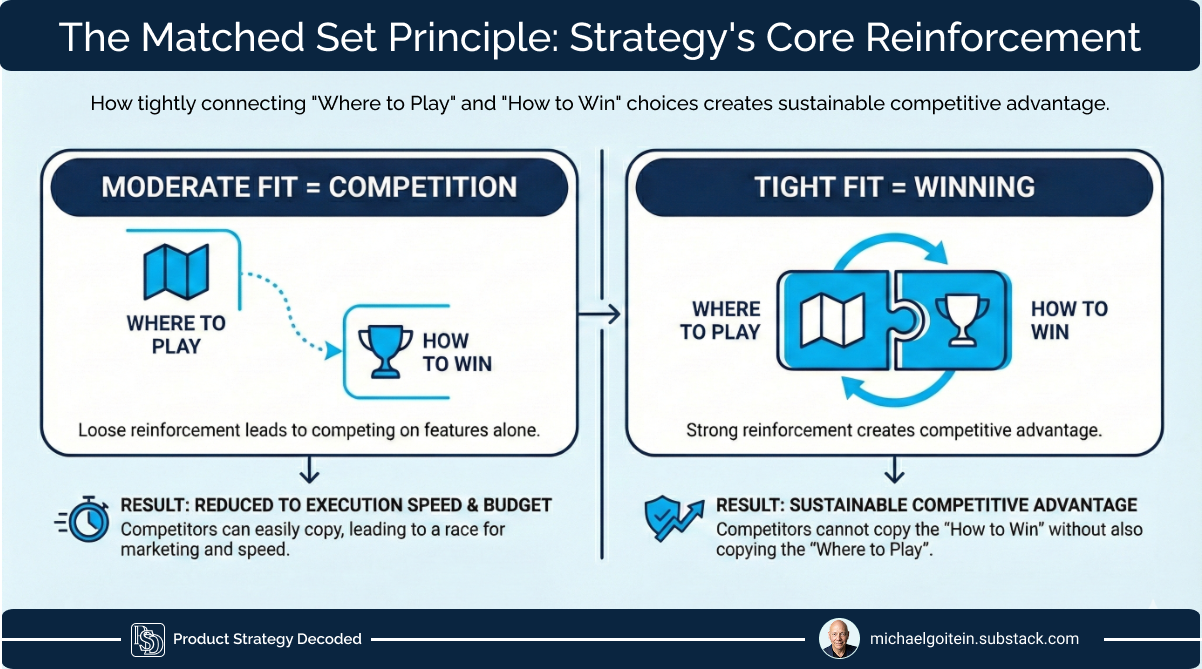
The core of your strategy comes down to two choices:
Where to Play: Which customers do you serve, to address which problems, in which contexts?
How to Win: What’s your differentiated approach to serving them?
The biggest mistake I see people make when learning strategy using the Strategy Choice Cascade is treating Where to Play and How to Win as two sequential decisions:
First, brainstorm potential markets or customer segments (Where to Play)
Prioritize that list at a workshop
Then, try to figure out a list of “How to Win” choices for each one
This feels logical. It’s how we’ve been taught to break down complex problems.
But it takes you deep into rabbit holes you should never go down in the first place.
Where to Play and How to Win are an inseparably matched pair. They’re a single decision expressed in two parts, not two decisions made separately.
Here’s why the sequential approach fails:
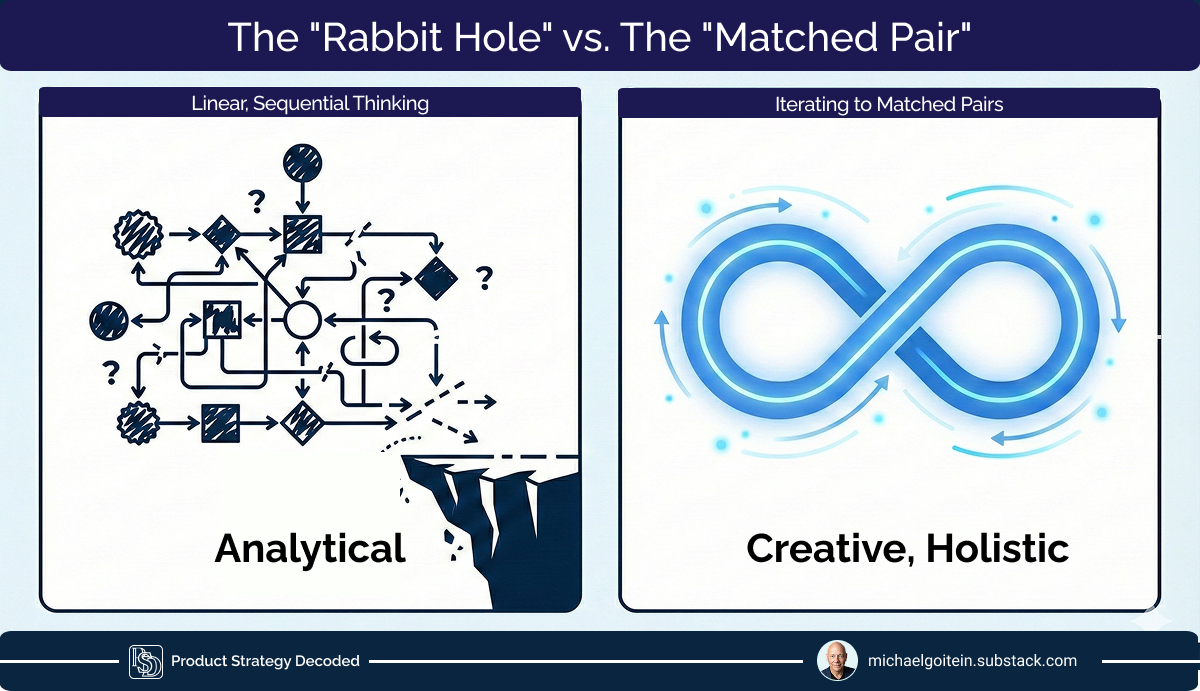
Without deeply thinking about your “How to Win,” almost any “Where to Play” looks interesting. You end up losing time thinking about long lists of potential customers, markets, and channels. “Enterprise customers.” “SMB teams.” “Developers.” “Non-technical users.” The list grows endlessly because there’s no filter.
These lists spread your strategic focus. Your team can’t focus on possibilities that might actually work because most of the list is purely theoretical. A Where to Play without a paired How to Win is just wishful thinking.
And when you finally turn to How to Win, you’re stuck. You go through each Where to Play trying to find a winning approach and come up with nothing. For most of them, there isn’t one. At least not for your team, given your capabilities and constraints.
So if you get stuck on a particular “How to Win,” the problem is almost always your “Where to Play.” You picked a market where you can’t actually win. The fix isn’t to brainstorm more “How to Win” choices.
The fix is to go back and adjust your “Where to Play” until a natural “How to Win” emerges.
The better approach is paired and iterative, not sequential.
When a potential “Where to Play” comes to mind, immediately ask: is there a “How to Win” that would make this a winning combination?
If yes, you might be onto something. Keep exploring this pair.
If not, ask: could this “Where to Play” be tweaked to enable a stronger “How to Win”?
If you can tweak it, try the new version. Keep iterating between the two choices.
If you still can’t find a viable pairing, discard that “Where to Play” entirely and move on. Don’t add it to a list. Don’t save it for later. It’s not a viable option for your team.
Never make lists of potential Where to Plays.
The moment you start keeping lists, you’re back to sequential thinking. The back-and-forth between Where to Play ideas and potential How to Win matches is what creates something real and powerful at the heart of any strategy: the matched pair.
A Where to Play is worthless without a paired How to Win. “We’ll serve enterprise financial services customers” isn’t a strategy until you know HOW you’ll win with those customers in ways your competitors can’t copy.
And a How to Win only makes sense for a specific Where to Play. Vanta’s “continuous trust” only works because its Where to Play (U.S. startups seeking enterprise deals) enables it. Expand that Where to Play, and the How to Win no longer has the same strength.
Key Principle: Effective strategy choice-making involves designing matched pairs where:
The Where to Play makes the How to Win especially valuable
The How to Win would be wrong for other customer segments
Each choice strengthens the other
Once you’ve seen this strategy First Principle, you can’t “unsee” it, and your entire approach to strategy will shift.
How Gamma Went From Near-Death to $100M ARR
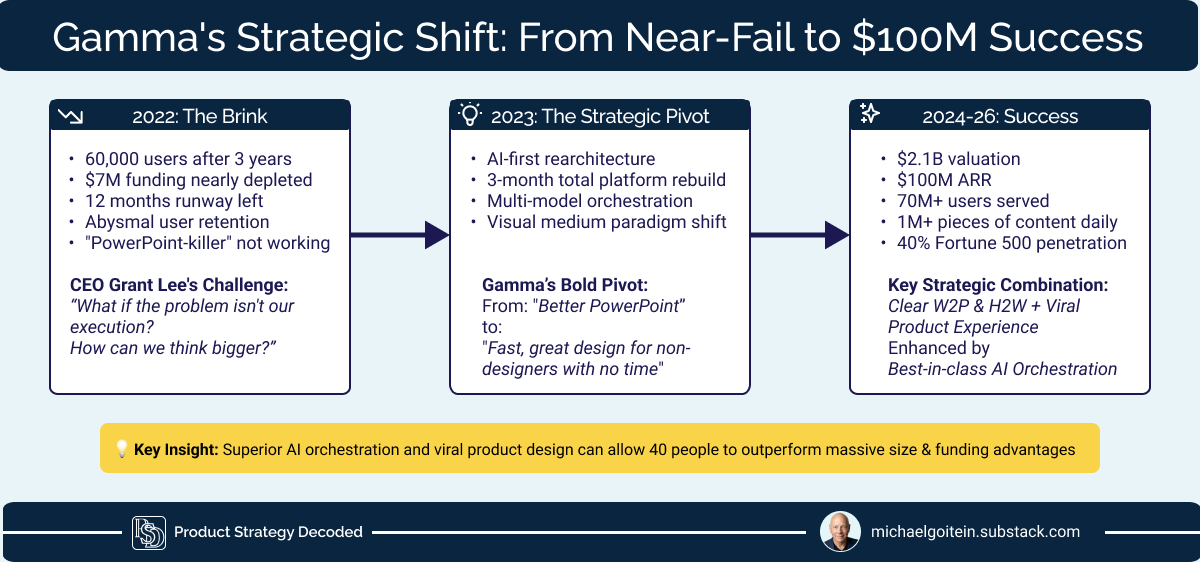
In 2022, Gamma had 60,000 users after three years. They were running out of money. Their strategy:
Where to Play: People who make presentations
How to Win: Better PowerPoint formatting
Apply the Match Test. Does “better formatting” ONLY work for “people who make presentations”?
No. Better formatting could work for anyone making any document. It’s generic and doesn’t differentiate in any important way.
They pivoted. Two connected choices:
Where to Play: Knowledge workers who need to rapidly
communicate visually but lack design skills and time
How to Win: AI-powered creation that transforms 10-word
prompts into polished presentations in 30 seconds
Match Test: Does “AI makes fast design decisions for you” ONLY work for “people who lack design skills and time”?
Spot-on.
The professional designers I know and work with daily have zero interest in AI making their design choices for them. They’d hate this product. People with time prefer to start from a sketch, carefully think through the structure, design, iterate, and nudge bullets and images, preferring to put their own stamp on the presentation. They’d find Gamma too limiting and unhelpful.
But knowledge workers without design skills, drowning in deadlines, who need quick, powerful presentations to communicate ideas? Gamma gives them exactly what they need. The intentional limitation becomes a key differentiating choice.
Matched set.
What Gamma fixed:
Its original strategy failed on two counts:
“People who make presentations” wasn’t a real Where to Play choice. Everyone makes presentations. The opposite (”people who don’t make presentations”) isn’t a viable alternative market.
“Better formatting” wasn’t a real How to Win choice. The opposite (”worse formatting”) is stupid. No one chooses that.
Their pivot created real choices that reinforce each other:
“Non-designers without time” is a real choice. Designers and people with time are viable alternative markets that competitors serve.
“AI decides for you” is a real choice. Full user control is what Figma and Canva offer.
AND these choices fit tightly: the Where to Play creates customers who see the How to Win as a feature, not a limitation.
Result: 60,000 users → 70 million users. $100M ARR. 40-person team.
Two real choices. Tight fit between them. That’s a matched set.
Read Gamma’s full strategy breakdown for free here:
The Matched Set Principle
Only part of Gamma’s success has to do with timing.
While many AI presentation tools launched in 2022-2023, Gamma still leads the category as the rest struggle to retain and grow a meaningful user base.
Despite pressure from Microsoft, Google, Canva, and Beautiful.ai, Gamma dominates because it understands that Where to Play and How to Win aren’t two separate decisions. They’re one decision expressed in two parts.
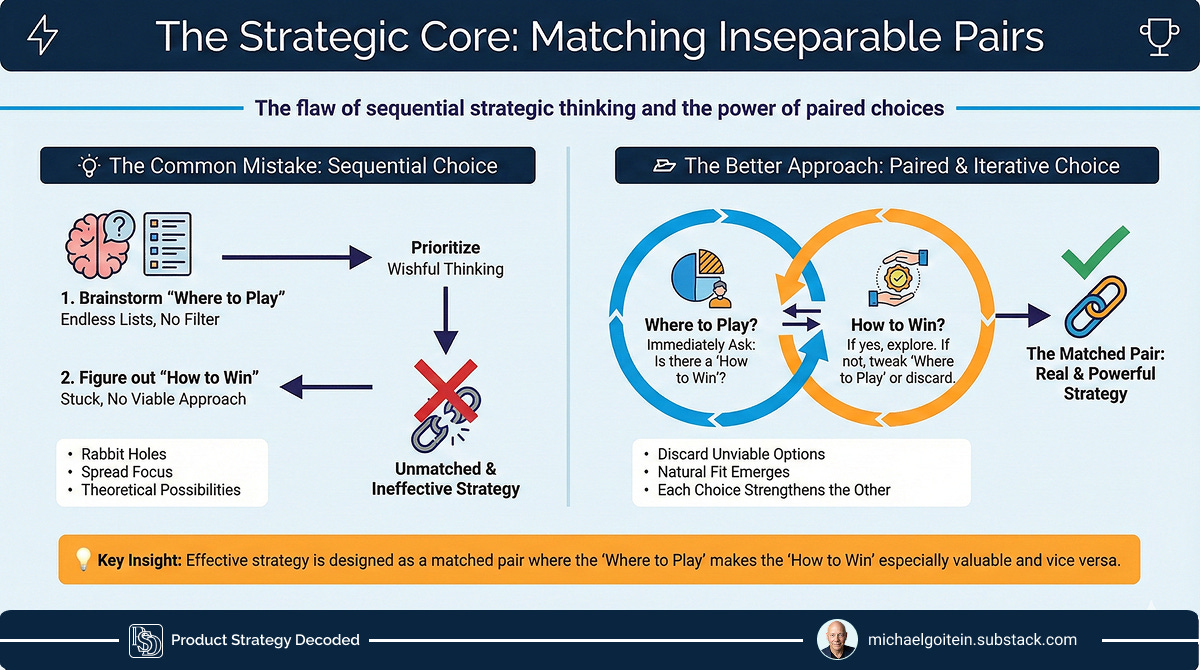
When they reinforce each other tightly, you create competitive advantage. Competitors can’t copy your How to Win without also copying your Where to Play. And if they’re already serving a different Where to Play, your How to Win would be wrong for their customers.
Moderate fit lets you play. Tight fit lets you win.
When the two choices don’t reinforce each other, you’re reduced to competing on features alone. Anyone can copy you. You’re competing on execution speed and marketing budget, not strategy.
What the Match Test Can’t Do
The Match Test can quickly reveal that something fundamental about your choices needs fixing.
It can’t help you design a strategy. But it can help you and your team start thinking more strategically.
If you don’t have a clear Where to Play statement, you can’t test it. If your How to Win is “we’re better,” there’s nothing with which you can match it.
The paid section below gives you the exact exercises, tools, & steps to fix this.
WHAT’S BEHIND THE PAYWALL
This week’s paid section includes:
📋 GOING DEEPER INTO THE STRATEGY CHOICE CASCADE We’ll dig deep into the complete 5-question framework. How each choice constrains and enables the next. And why it’s so important to start and match in the middle, not at the top.
⏱️ THE 15-MINUTE “MATCH TEST” EXERCISE A step-by-step exercise to draft your Where to Play and How to Win, apply the Match Test, and diagnose any problems. Designed for solo work or with your product trio.
📊 THE DIAGNOSTIC FRAMEWORK When the Match Test fails, you need to know WHY. Is it a choice problem (binary) or a fit problem (degree)? Different root causes require different fixes.
🤖 AI-POWERED STRATEGY ANALYSIS (NEW) Two prompts designed specifically for this exercise. Use them with Claude, ChatGPT, or Gemini to design and pressure-test your choices. They’re built to ask the hard questions and present options you may not have considered.
You just learned the Match Test. Paid subscribers get the complete framework to apply it.
This is Chapter 1 from “Playing to Win for Product Teams.” I’m writing this book for product trios, and your feedback shapes what makes it into the final version.
Remember that RICE score of 1,200 for a feature nobody wanted?
Paid subscribers get an exercise and prompts to sharpen two key strategic choices that most teams never think about.
Get them right, and you’ll have a lens to shorten every roadmap debate to a 5-minute conversation.
