
This Week In The Autonomous Agent Race
Google, Anthropic, Microsoft, and Cursor make waves in the future of Agentic AI

Read time: 3.7 mins.
Four companies laid the foundation for agentic AI’s continued evolution.
While many still chase better benchmarks and linear interactions, Google, Anthropic, Microsoft, and Cursor are investing for a future that’s already here.
They’ve built infrastructure for agents that work and improve without human oversight.
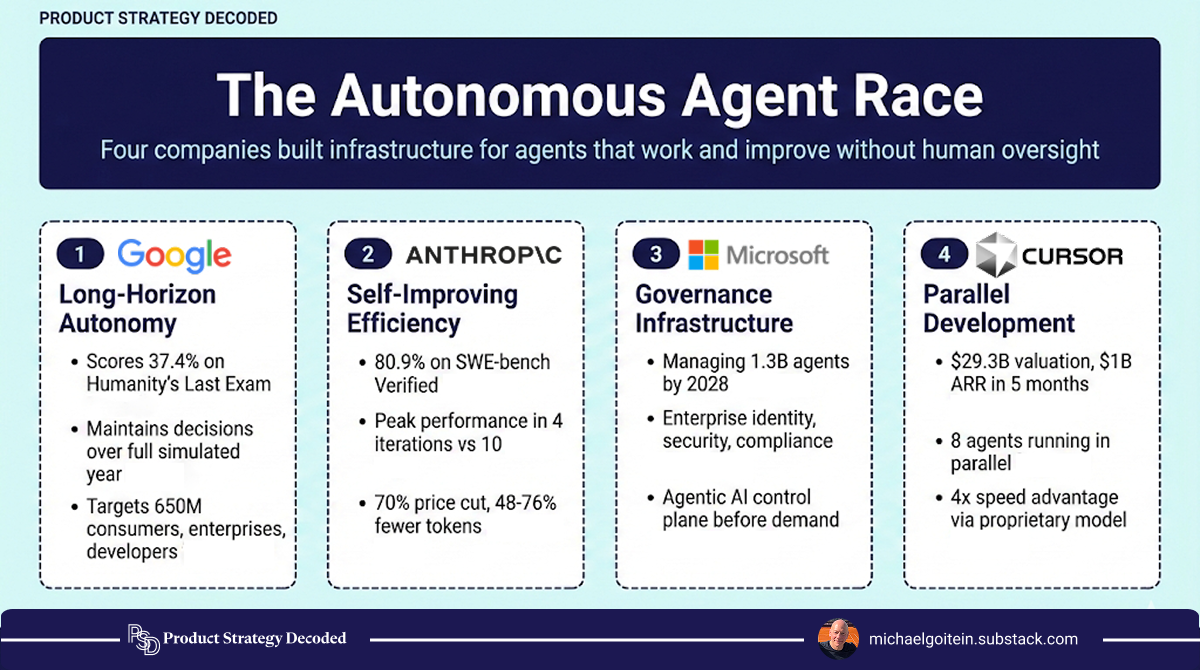
1. Google’s Gemini 3 Plans Consistently Across Full Simulated Years
Google launched Gemini 3 on November 18, 2025, scoring 37.4% on Humanity’s Last Exam, triggering OpenAI’s Sam Altman to declare “Code Red” forcing OpenAI to roll out its next 5.2 model ahead of schedule, beginning on December 11, 2025.
Google saw “context rot” as an existential threat. Understanding agents would need extended time-based reasoning, Google built Gemini 3 to maintain consistent decision-making over a full simulated year.
Gemini 3’s “Where To Play” targets three customer segments: enterprises via Vertex AI; 650 million monthly active consumers via the Gemini app; and individual developers via Google AI Studio and Gemini CLI, and the new Antigravity platform.
Can’t/Won’t: Most customer-focused, model- and consumer-only vendors wouldn’t invest in long-horizon planning infrastructure when the market only rewards benchmark and chat interface improvements.
2. Anthropic’s Claude Opus 4.5 Model Achieves Performance While Slashing Cost
Anthropic released Claude Opus 4.5 on November 24, 2025, scoring 80.9% on SWE-bench Verified while cutting prices by nearly 70%. Astoundingly, Opus features self-improving agents that achieve peak performance in just four iterations compared with competitor models that require 10.
Claude Opus 4.5 targets developers and enterprise teams through APIs and high-profile integrations with Snowflake, GitHub Copilot, Cursor, and Lovable. Opus couples its improved performance and pricing with massively increased token efficiency, requiring 48-76% fewer output tokens than competitors.
Anthropic’s business-focused, vs. consumer-focused “Where to Play” has made all the difference, as CEO Dario Amodei said his company can just keep “growing and developing our models” without the need to “declare any emergencies.”
“You just focus on different things, less on engagement, more on coding, high intellectual activities, and scientific ability.”
Can’t/Won’t: Competitors will be hard-pressed to match Anthropic’s advances in autonomous training or pricing structures while simultaneously improving efficiency and dropping prices by 67%.
3. Microsoft Ships Agent Governance Before the 1.3 Billion Agent Explosion
Microsoft announced Agent 365 at Ignite in November, its platform for managing what IDC projects will be 1.3 billion agents globally by 2028.
Microsoft is avoiding competing at the model or interface level to focus on the agentic AI control plane. Agent 365’s “How to Win” extends Microsoft’s dominance in enterprise identity with Entra Agent ID, security with its AI-powered threat detector Defender, and automated compliance and reporting via its Purview tool to manage agents.
Microsoft is betting enterprises will need an enterprise-grade agentic AI management layer to own governance of all other agents, regardless of origin. The security and reputational risks to any enterprise that does not effectively manage its agents could be catastrophic.
Can’t/Won’t: Competitors can’t offer Microsoft’s unified identity layers across diverse agent ecosystems, or invest in expensive governance infrastructure before enterprise demand materializes.
4. Cursor’s $29.3B Valuation Proves Autonomous Coding at Enterprise Scale
Cursor secured $2.3 billion in Series D funding in November, tripling its valuation from $10 billion to $29.3 billion in just five months. Cursor achieved that valuation by reaching $1 billion in ARR while spiking enterprise revenue growth by 100x.
Ironically, Cursor’s success stems from focusing on a niche AI application: developer productivity. Its 2.0 multi-agent architecture enables engineers to run up to 8 agents in parallel, reducing development timelines from linear to parallel execution.
As we saw with Gong training its models on sales calls, Cursor trained its proprietary Composer model using Reinforcement Learning across hundreds of thousands of concurrent sandboxed cloud-based coding workspaces, achieving a 4x speed advantage over general-purpose models.
Can’t/Won’t: By training its proprietary Composer model across the complete development cycle, learning to generate, integrate, test, and improve code within live workflows, Cursor has achieved a level of continuous agent-driven collaboration that GitHub Copilot and Replit’s Agent can’t deliver.
📊 THIS WEEK’S SIGNAL
These four companies are building agents for workflow reimagination and increasingly autonomous operation.
Google’s betting on long-horizon autonomy. Anthropic’s betting self-improving agents reach solutions faster. Microsoft’s betting mass agentic AI deployment needs governance infrastructure. And Cursor’s betting enterprises and individuals will adopt parallel agentic coding.
All four are building the independent agentic AI infrastructure of the future.
For Your Product Strategy
Which of your features could evolve from assisted tools to autonomous agents?
Where are you optimizing for supervised, linear interaction when autonomous and parallel workflows could unlock more value?
What governance infrastructure will be necessary before demand materializes?
What aspects of your product could improve autonomously without your team’s intervention?
📖 REVISED, EXPANDED & UPDATED: The Lovable Strategy Breakdown
This week, I went back and completely revised, updated, and expanded my reverse-engineered deep-dive of vibe-coding platform Lovable’s product strategy.
This version features Sabrine Matos, a woman who’s literally saving lives with Lovable. I also break down three new strategic moves that most AI product companies are still missing, and how tie-ins with Gemini 3’s Nano Banana for image generation and Claude’s latest Opus 4.5 model are delivering vastly faster, higher-quality results.
Read the complete revised strategy breakdown →
Join me next Friday for the next set of strategic moves!
An incredible write-up, as always, Mike.
As I mentioned in LinkedIn, there's one more big thing that I think deserves a mention - Cursor has finally opened their API for third-party integrators.
This has allowed us to be the first product-focused company to launch our agents management model. After you define what your product team is going to be working on and what are those requirements, it will be broken down into the right tasks for Cursor and/or agents will manage that development end-to-end.
By the time that you create tasks for your engineers, they have a draft PR for everything they need to do.
That was a great summary Mike! I didn't know about Cursor's valuation. Thank you for sharing and happy weekend!